Cataloging as an Act of Care
Between 2023 and 2026, the American Folk Art Museum (AFAM) developed the project Rethinking Biography to strengthen the stewardship of its twentieth- and twenty-first-century art holdings. This collection-based initiative, with a particular focus on neurodiversity, prompted a reassessment of how works historically associated with self-taught art (and art classified under related terms) are acquired, documented, exhibited, and interpreted.
Each object that enters the Museum collections arrives with its unique story. How those stories are approached and cataloged significantly influences an artwork’s subsequent contextualization through exhibitions, programs, and publications. Artists who work outside of conventional systems—such as art schools, galleries, and peer-exchange networks—usually resist easy categorization. They embody an exceptionally vast range of individual trajectories. Their practices are rooted in and informed by diverse sites of learning, including professional expertise, personal experiences, and community-based traditions. The convergence of art and daily life has an especially strong impact on the recognition and preservation of their works. These contexts can also lead to interpretations that place greater emphasis on biographical information.
Throughout the Rethinking Biography project, AFAM acknowledged the specificities of each artist’s journey, while refraining from sensationalizing their origins. The work that has been initiated must remain ongoing to be truly valuable. The results uncovered by this project will be continually revisited and updated to reflect new institutional practices and scholarship.
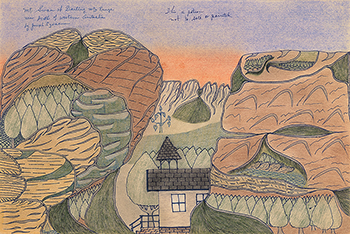
Image: Joseph E. Yoakum (1891, Ash Grove, Missouri–1972, Rock Island, Illinois). Mt. Swan of Darling Mtn Range Near Perth of Western Australia, Chicago, Illinois, January 8, 1968. Colored pencil, pastel, ballpoint pen on paper, 12 x 18 in. American Folk Art Museum, New York, Gift of the Anthony Petullo Collection, 2025.7.1. Photo by American Folk Art Museum
AFAM’s Collection: Mapping the IMLS Project
AFAM’s art collections are composed of over 7,500 works of art spanning four centuries and representing nearly every continent. Its area of specialization has often developed reactively, in response to the exclusion of artists and artworks from mainstream institutions. For this project, 155 artists were identified. The selection process was guided by the following set of criteria, designed to provide a framework that will remain relevant beyond the current project:
- Artists who self-identify as neurodivergent, using either that term or other related language.
- Artists whose work was collected by and entered the Museum collections because of historical connections with self-taught art, art brut or adjacent fields, with a special focus on artists associated with unspoken, veiled, or overt references to neurodiversity, mental illness, disability, and marginality.
- Artists whose practice developed within artist studios such as Creative Growth Art Center and Healing Arts Initiative, which advance the inclusion of people with disabilities and/or mental health conditions in contemporary art and strengthen community.
- Artists whose life histories intersected with or were impacted by systems of psychiatry, mental health, institutionalization, criminal justice, and other societal power structures.
The recurrence of these circumstances across the selected artists underlines the prevalence of systemic issues of authority and inequity for self-taught artists.
The terminology employed to identify these artists has undergone significant evolution over time, and it continues to develop in the present day. A primary focus of Rethinking Biography was to reevaluate this language—rarely adopted by the artists themselves—characterized as intellectual constructs that emerged within specific historical contexts.
The 155 artists selected for Rethinking Biography include both living and historical creators working with various media, including painting, photography, sculpture, art environments, ceramics, drawing, collage, and textiles. Their lives represent a spectrum of experiences in terms of race, sexuality, gender identity, and nationality. Extensive scholarship exist on some of the artists; information about others is still being uncovered. Throughout the project, it was paramount that the art itself remain at the forefront of our examination and that emphasis be maintained on the creators’ agency.
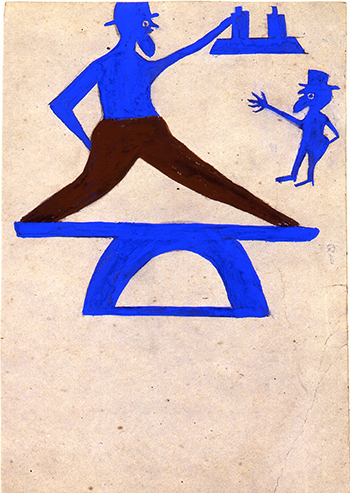
Image: Bill Traylor (1853, near Pleasant Hill and Benton, Alabama–1949, Montgomery, Alabama). Untitled, Montgomery, Alabama, 1939–1942. Poster paint and graphite on cardboard, 10 3/4 x 15 in. American Folk Art Museum, New York, Gift from the Estate of Lanford Wilson, 2022.24.1. Image courtesy Ricco/Maresca
Rethinking Artist Biographies
A new biography was written for each of the 155 artists selected for this project—all accessible on the Collection page of AFAM’s website. Primary sources were given the greatest weight; this included the art itself, which may be read (with appropriate critical reservation) as a firsthand account of the self, akin to a diary, and as an expression of an artist’s intended legacy. Equally important were the artists’ own accounts of how materials were sourced and used. Descriptions of processes and practices took into account the artists’ motivations, whether it was an attempt to channel the spirit world (Madge Gill) or the creation of memorials for a community (William Edmondson).
Biographies of formally trained artists often emphasize art education to illuminate artistic lineage and influences. For self-taught artists, diverse sources of learning—including community, ancestral knowledge, work, family, and spiritual practices—need to be treated with equal significance, as reflected in our biographical texts. Likewise, we considered exhibition histories for the work of self-taught artists beyond the spheres of the mainstream art world, encompassing not only museum exhibitions but also self-initiated displays. For example, Jesse J. Aaron used his front yard in Gainesville, Florida, as a gallery for his sculptures, and Lee Godie spread her works in front of the Art Institute of Chicago, promoting herself as the city’s own “French Impressionist.” We also examined how artists’ work entered the marketplace and museum collections, and the extent to which the makers were or were not involved in those processes.
Biographies of self-taught artists have often foregrounded perceived limitations, including disability and mental illness. Omitting these considerations entirely, however, can restrict opportunities for members of marginalized communities to see themselves represented in museums. Sensitively recognizing, rather than erasing, these aspects of artists’ narratives can also help shift the perceptions of people with similar experiences. For an artist such as Hawkins Bolden, who was blind, the materiality of his work—with its physical textures and acoustic quality—testifies to its tactile production. For Melvin Way, the circumstances of his psychiatric hospitalization and homelessness informed the ephemeral nature of his works on paper. Kambel Smith, who builds architectural models from discarded cardboard, created a science-fiction world with his family members in which he reframes his autism as a superhuman ability.
Some artists selected for Rethinking Biography have few primary sources; for Perley Meyer Wentworth, for example, a telephone directory listing is among the main references. There is often a disparity in how self-taught artists are documented during their lifetimes, and, unlike many mainstream artists, they frequently lack the institutional relationships that might ensure the preservation of their estates. Greater attention to these artists underscores the need to proactively care for their legacies. Accordingly, posing questions for which we don’t have clear answers was part of the framework for writing these biographies. As living documents, they will be updated as new information becomes available and new conversations emerge.

Image: Adolf Wölfli (1864–1930, Switzerland). Untitled, Waldau Clinic, Bern, Switzerland, 1918. Graphite and colored pencil on newsprint, 34 x 24 1/2 in. American Folk Art Museum, New York, Gift of Audrey B. Heckler, 2025.14.16. Photo by Adam Reich
An Artist-Centered Project
The exhibition Self-Made: A Century of Inventing Artists, presented at AFAM from April to September 2026, grew out of the Rethinking Biography metadata review process, with many of its artists featured in the project. The curatorial approach to the exhibition foregrounded the artists’ voices and placed their work at the center of interpretation, demonstrating how the project’s principles could inform the presentation of self-taught art. For instance, in support of this goal, most object labels for untitled works included inscriptions made by artists on their works, captured during cataloging.
Self-Made examined how artists without academic training have depicted, conceptualized, and identified themselves on their own terms through three modes of artistic self-fashioning: self-portraits, depictions of alter egos, and signature pieces. In doing so, the exhibition challenged reductive and longstanding narratives that have cast these artmakers as amateurs working outside of time, without lineage or influence.
Too often, exhibitions involving self-taught artists emphasize biographical details over the work itself, perpetuating stigmas associated with incarceration, mental illness, disability, and neurodivergence. Questions of institutional confinement, consent, unequal relationships and social barriers, and rightful ownership shape how artists’ narratives are constructed. Reinforcing the artist’s agency and self-representation was therefore central to Rethinking Biography—an approach articulated in Self-Made.
From Catalog Records to Exhibition Labels
Information about artists and their work recorded by museums in their collection database ultimately finds its way into exhibitions, programs, and publications. The styling of artwork entries and exhibition labels can vary widely from one institution to the next. What they contain may seem straightforward—the who, what, when, and where of a work—but works by self-taught artists present additional challenges during cataloging, notably because many have been collected without titles, dates, and clear provenances, among other essential details. Prioritizing the documentation of these fields during the acquisition process, as recommended in this project, is key to establishing a more robust foundation for future research on self-taught artists.
The Rethinking Biography project outlined a metadata review of over 1,000 works and their public-facing fields (artist’s name, life dates, artwork’s title, place created, date of creation, medium, inscription). Below is an example of AFAM’s label approach for a drawing by James Edward Deeds, Jr., exhibited in 2026’s Self-Made: A Century of Inventing Artists:
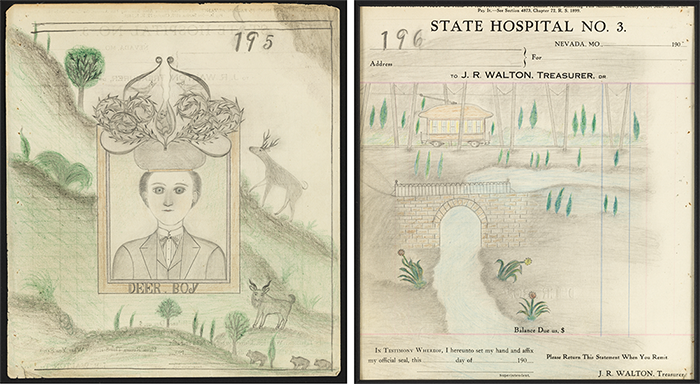
- Artist: James Edward Deeds, Jr. (1908, Panama–1987, Springfield, Missouri)
- Title: Pages 195 and 196 from untitled and handbound sketchbook
- Place created: State Hospital No. 3, Nevada, Missouri
- Date: 1936–1969
- Medium: Graphite and crayon on ledger paper (double-sided)
- Dimensions: 9 1/4 x 8 3/8 in.
- Credit line and Accession Number: American Folk Art Museum, New York, Promised Gift of Frank S. Tosto, P1. 2026. 1a,b
Artist: As the first line indicates, the artist’s full name is known, but it was uncovered only years after the handbound sketchbook was found in the trash in Springfield, Missouri, in 1970. Members of Deeds’s family later confirmed his life dates and key elements of his biography. When an attribution remains unresolved, AFAM records the designation “Artist Unidentified” in the database. To specifically address attribution for the 155 artists selected, Rethinking Biography provided an opportunity to improve findings regarding artists’ names, alternate names, name spellings, life dates, and related locations. This information may reflect lived experiences related to immigration, legal status, marriage, and shifts in identity over the course of a life. Updates were based on searches of government records—including birth and death certificates, draft cards, and Social Security and immigration records—newspaper reports, gravestones, and AFAM’s archives and accession files.
Title: The question of title also requires special attention for works by self-taught artists. Because existing titles may not have been captured during an artist’s lifetime and may be assigned without the maker’s involvement, it was important to determine whether an artist had a documented titling practice. In the absence of an artist-given title, we cataloged the work as “Untitled.” In James Edward Deeds’s work, the page numbers indicate that it is not a standalone object but a part of a larger ensemble—here a 283-page untitled and handbound sketchbook—such as an art environments or costume.
Place created: Although not consistent across all museums, AFAM’s object labels usually identify where a work was created, situating it within a fuller cultural, geographic, and historical context. This information varies in its level of detail but can be as specific as identifying the creative art center with which an artist is affiliated, a prison, or a psychiatric institution, such as State Hospital No. 3 in Nevada, Missouri, where Deeds was institutionalized.
Date: Metadata review highlighted that dates of creation are often missing for self-taught artists. Historically, dating an artwork has not been common practice for them as it is for formally trained artists, who use the process to keep a record of their production. The status of the object, the context of acquisition, and the nature of the work, often created over an extensive period of time, complicates this practice. As we reviewed AFAM’s entries, when a date was not recorded, a range was applied. Deeds was committed in 1936; although he died in 1987, the discovery of his album of drawings in 1970 places the end date in 1969.
Medium: Another typical component of an object label is the medium. Expanding scholarship on self-taught artists has yielded more nuanced understandings of their intentional selection and idiosyncratic use of materials. Therefore, our metadata review aimed at providing a more exhaustive list of materials. Detailed description of materials, when paired with the “place created,” adds meaningful biographical context and a broader understanding of the artist’s positionality. For this specific page of his album, Deeds used crayon and graphite to draw on both sides of a piece of ledger paper recycled from the hospital.
Scholarly Resources
How can museums advance the long-term recognition of self-taught artists while fostering greater inclusivity? How can they cultivate cumulative scholarship that expands and deepens understanding of these artists over time? How can this knowledge be translated into meaningful public engagement and shared in ways that reflect museums’ commitment to accessibility and engagement?
AFAM’s Rethinking Biography project provided an opportunity to start addressing these questions, notably through the development of robust internal scholarly files for each artist selected for the initiative. These resources bring together primary and secondary sources, correspondence, images, and references to relevant holdings in the Museum’s archives and accession files. They offer a centralized, expandable resource on artists and related subjects, individuals, and organizations, to support future metadata reviews, cataloging, and programs.
Improving Visibility: Photography of the Collection
If an artwork does not have an image in a museum catalog, it is less likely to be exhibited and studied. Rethinking Biography allowed for the completion of photography for over 250 objects, now accessible on the Museum’s website, to which newly digitized photographic portraits of artists were also imported.
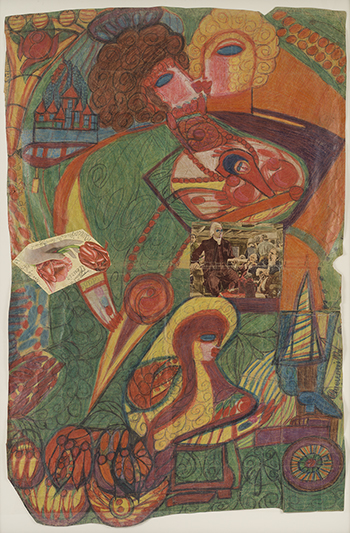
Image: Aloïse Corbaz (1886–1964, Switzerland). Untitled, La Rosière Psychiatric Hospital, Gimel-sur-Morges, Switzerland, c. 1956. Colored pencil, graphite, sewn paper cutouts on wrapping paper, 47 5/8 x 30 1/2 in. American Folk Art Museum, New York, Gift of Audrey B. Heckler, 2025.14.2. Photo by Adam Reich
White Paper: Findings and Recommendations
Rethinking Biography led to the publication of a white paper—a comprehensive report accessible here that gathers research findings and analysis on the project, as it relates to AFAM’s areas of expertise. Its content expands on the issues presented on this webpage. Across three interconnected chapters, the white paper surveys terminology associated with self-taught art, examines epistemological issues raised by artists in this field in relation to the institutionalization and art-historical recognition of their work, and concludes with recommendations for museum professionals concerning documentation, management, and access. Interviews and consultations with key Museum staff and external museum professionals formed a cornerstone for the white paper. Their perspectives anchored and enriched our examination of emerging best practices across the museum sector.
This initiative was uniquely centered on artists and related questions of authorship and positionality. Self-taught artists can serve as catalysts for institutional self-reflection, prompting more systematic consideration of their inclusion across the broader spectrum of museum methodologies. As argued by Cristina Agostinelli, Curatorial Attaché and Head of Programming at the Musée National d’Art Moderne—Centre Pompidou, working with self-taught art “requires a shift in perspective. We think we are speaking on behalf of the artists and protecting their interest. Yet can such participation ever be fully realized without applying a form of ‘institutional psychotherapy’ to the museum itself? It is precisely through the involvement of all stakeholders that we avoid embodying forms of absolute authority.”
For the white paper, we asked Rachel Rosen, AFAM’s Director of Learning and Engagement, and her team to reflect on how working with artists historically associated with folk art, outsider art, self-taught art, and art brut shaped their practice, approaches, considerations, and interpretive strategies. She responded, “When our Museum Educators teach, they generally lead not with biography but with sustained investigation, open-ended inquiry, and multimodal engagement with the artwork. We help visitors see themselves reflected in the works we discuss: many have or will acquire a disability over the course of their lives, and many know or care for someone who is neurodivergent or has a disability. It is incredibly meaningful that visitors can come to AFAM and so often encounter the work of artists with disabilities and neurodivergent artists.”
The findings explored in the white paper establish a sustainable foundation for future research, cataloging, and interpretation. By emphasizing artist agency, transparency, and cumulative knowledge, this thoughtful initiative, publicly accessible, outlines a framework, guiding principles, and practical recommendations that remain adaptable as scholarship evolves and museums continue to reassess their social and ethical responsibilities to self-taught artists.
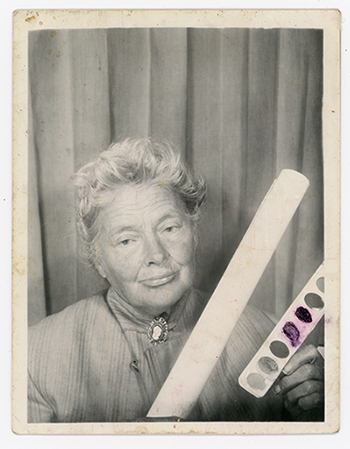
Image: Lee Godie (1908, Chicago, Illinois–1994, Plato Center, Illinois). Untitled (‘Lee in a large hate.’), Chicago, Illinois, 1970s. Ballpoint pen on photograph, 5 x 3 3/4 in. American Folk Art Museum, New York, Gift of Charles B. and Janice M. Rosenak, 2024.14.1
Credits
Access the list of the project team and consultants here.
© 2026, American Folk Art Museum, New York
To cite this project: Rousseau, Valérie, with Allison C. Meier and Brooke L. Wyatt, Rethinking Biography, edited by Valérie Rousseau (New York: American Folk Art Museum, 2026). An initiative supported by the Institute of Museum and Library Services (IMLS).
Image (header): Yuichiro Ukai (b. 1995, Japan). Yōkai, Shiga Prefecture, Japan, 2019. Marker, colored pencil, ink on cardboard, 29 x 32 1/2 in. American Folk Art Museum, New York, Eva and Morris Feld Folk Art Acquisition Fund, 2020.9.1. © Yuichiro Ukai

“The Neurodiversity Project” [MA-253388-OMS-23] titled Rethinking Biography received the generous financial support of the Institute of Museum and Library Services (IMLS). The views, findings, conclusions or recommendations expressed in this webpage do not necessarily represent those of the IMLS.